
Data Science
Data Science in Farming
G’s stands out as a pioneering agricultural enterprise in the UK, leveraging Machine Learning and Artificial Intelligence to enhance the production of our salads, thereby bolstering food security.
Strategic insights gleaned from sophisticated crop models inform our sowing and planting schedules, ensuring a consistent supply that meets customer demand throughout the season.
Variable weather patterns can accelerate or decelerate crop growth, leading to fluctuations in availability. Our state-of-the-art ML and AI models play a crucial role in real-time monitoring of these conditions, enabling precise assessment of crop growth against our projections.
With this advanced knowledge, our growing teams can adjust in-season sowing to address gaps in availability, ensuring that our customers have access to fresh, nutritious salads.
Using Machine Learning and AI in our FreshCAM model, our growers make smarter decisions about when to sow their crops and how to manage them more effectively to get the right volumes at the right time."
Weather is our best ally and our greatest challenge
The weather provides key resources for plants to grow in the field in the form of light, temperature and water. However, varying climatic conditions are the greatest challenge to secure an steady availability of crop at supermarket shelves across the season.
As days become warmer and longer, crop grows faster in the field. For instance, for Iceberg lettuce, the first lettuces planted in February take up to 90 days to become ready for harvest, while those planting in June will be ready in around 45 days.
Achieving the volumes agreed week on week is a challenge for our growers. Should they plant the same amount of crop daily, there will be surpluses early in the season. That’s why we are using average weather conditions to establish the most suitable growing cycles.
However, the weather is never average, not to say that climate change is definitively exacerbating extreme weather events.
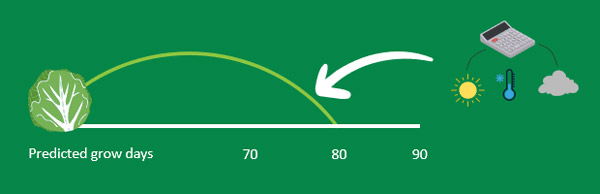

The Secret Sauce - FreshCAM
Three models form the G’s AI and ML family, based on different technologies.
Statistical models are being used very effectively, given their high level of explainability. These are the ones we have been using the longest and have driven the digitalisation of the agricultural supply chain from seed to store.
Machine Learning models (ML) are easier to extend beyond climatic parameters and offer a very versatile platform to explore the relevance of other ‘features’ in crop maturity. Additionally, they are offering improved accuracy at the beginning and end of the season.
Mechanistic models will enable growers to adapt their crop management in real time when deviations from standard growth exceed certain boundaries. Also, they lay the foundation for a digital-twin of the crop, providing a great platform to work on “what-if” scenarios.
Through the evolution of our statistical model IceCAM, we have achieved a breakthrough with our FreshCAM model family, integrating ML and mechanistic modelling to set new industry standards.
Capturing Big Data – EarthRover
The quest for comprehensive crop physiology data is the cornerstone of AI model development and deployment in agriculture. This data is crucial for objectively quantifying the impact of environmental and agronomic interventions on crop growth.
At G’s, we have been amassing crop physiology data for our Iceberg lettuce through manual sampling. This method yields approximately 20,000 samples per season, but it only represents a tiny fraction (0.0003%) of our total harvest.
The deployment of EarthRover, an advanced crop scouting robot, marks a significant leap forward. Capable of collecting about 100,000 samples daily, it propels us closer to achieving Big Data in agriculture. Despite technological challenges, particularly post-canopy closure, EarthRover is a pivotal tool in enhancing our FreshCAM model. We continually seek other technologies to improve our data capture.