
Johnson Su
Our Target State is to reduce greenhouse gas emissions by 45% by 2030. We recognise our transition to regenerative practices is key to support this ambition.
We continue to make progress, as we increase our engagement and experimental trial work across our farms, learning from each other and sharing our successes and failures as we:
- Incorporate cover cropping into our rotations
- Reduce all forms of soil disturbance
- Improve crop nutrition programmes to grow healthier plants and increase our soil biology.
- Enhance biodiversity above and below ground
At our 2025 Farming Conference “Regen into action” our teams across the UK, Spain and Poland shared the work they are doing to drive our use of Johnson Su biological inoculants and broader regenerative practices.
At our February 2025 Farming Conference 'Regen into action' our farming teams shared the trials that they have been undertaking to increase our use of Johnson Su . ”
Johnson Su - Background
Johnson-Su is a static aerobic composting method designed by microbiologists David Johnson and Hui-Chun Su.
The method uses materials entirely from one’s own farm to generate a microbially diverse compost that is rich in fungi and higher trophic level microorganisms.
The compost can be applied to pasture or cropping systems to inoculate soil, particularly in the root zone of living plants, with a broad spectrum of microbes.
The method is dissimilar to many “bugs in jugs” products as the compost is not used for culturing specific strains of microbes, rather generating a biological flood effect where community complexity is the goal. Increased abundance and diversity of microbial life in soil is linked with increased nutrient availability, increased carbon cycling and improved soil structure.
Building our Bio-Reactors
We began building our first bioreactors in 2022. Using materials collected from around Cambridgeshire Farms including woodchip, maize, straw, cover crops, reeds, weeds and more in a ratio of 50:50 green to brown, we put together a mix full of plant diversity.
The material was thoroughly mixed, wetted through with non-chlorinated water and loaded into 40 IBCs into which 4 wooden posts were driven. Once the material settled, the posts were removed to create air channels down through the mixture to keep it aerobic.

We are now on our 4th batch of Johnson-Su bioreactors, the process has remained largely the same, always maintaining a focus on diversity and the Brown:Green (or C:N) balance. ”
The Composting Process
Once assembled, the bioreactors rapidly reach temperatures of over 70 degrees C as the material is broken down predominantly by bacteria. This thermal stage can help sterilise weed seeds and kill off certain pathogenic microbes.
Once the initial flush of bacterial activity slows and temperatures drop to ambient, composting worms are added to the bioreactors. The worms facilitate the breakdown of the organic matter and help aerate the compost.
Over time, as the compost breaks down, the microbial community composition changes with slower growing microbes that thrive in low disturbance such as fungi, protozoa and nematodes beginning to dominate.
Diversity booms in the last month or two of the composting process as established predator-prey cycles stabilise to generate a fully mature compost at around 400 days that has a staggering diversity and abundance of microorganisms. We validate this using microscopy and PLFA tests to analyse the microbial profile.
Application
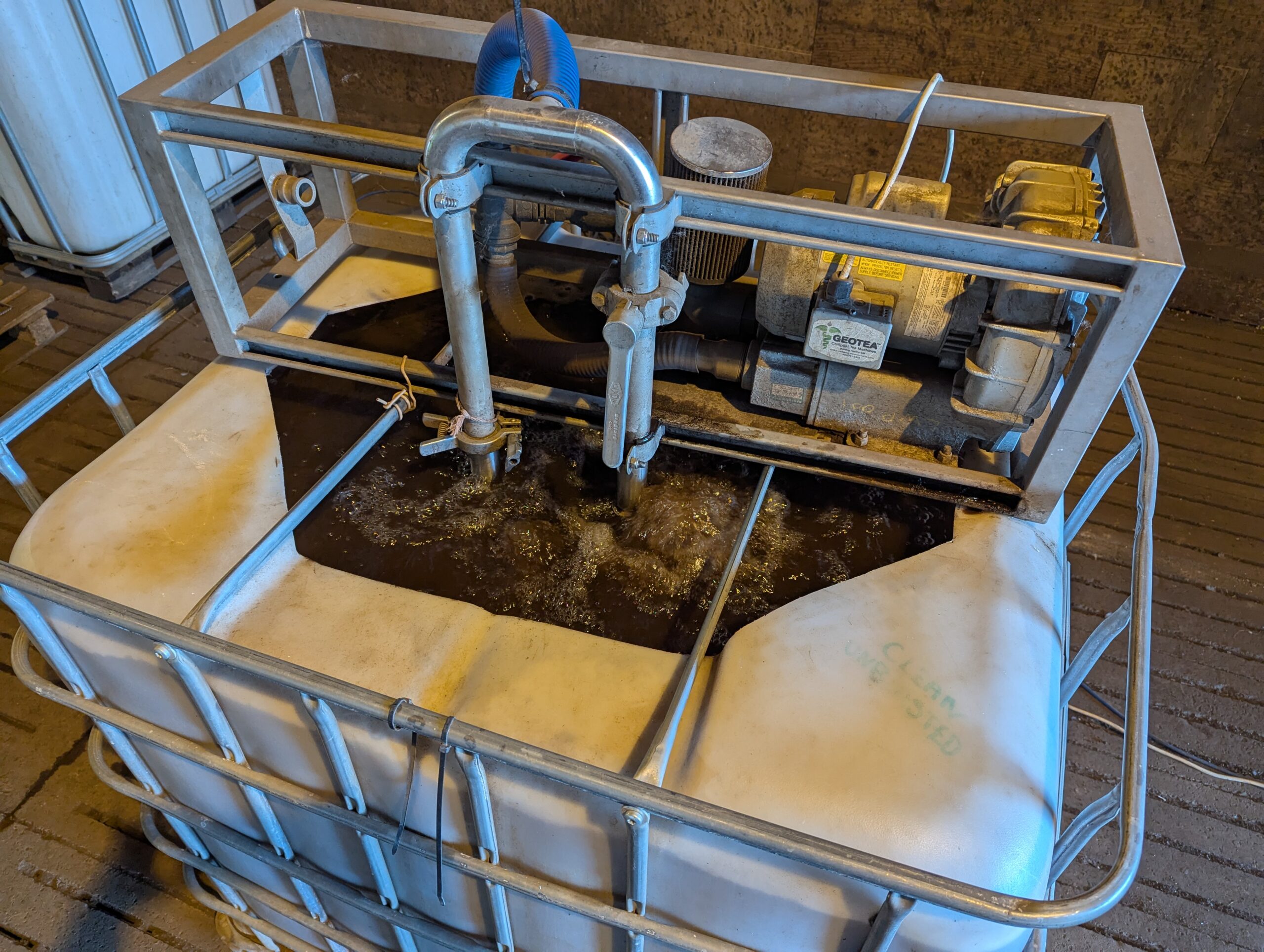
A liquid extract is generated by bubbling the compost in rainwater, using oxygen to wash the microbes and soluble nutrition into solution. The resulting extract is applied directly to the seed or root zone of a developing plant.
After successful trials of increasing area in 2023 and 2024 at Cambs Farms, we have up-scaled production this year to an estimated 400,000L over the season, with the extract applied as standard on all salad and root crops.
Across the broader G’s farming businesses in the UK, Spain, Poland and Senegal, growers are developing their own bioreactors and are underway with application trials.
Recently we have developed a method for applying a compost slurry as a seed dressing; this is now the preferred method for dressing cover crop seeds and has been trialed this year on arable crops and radish.
Results & Improvement
Trials have shown an improvement in growth and consistency as a result of a biologically enhanced system that includes Johnson-Su application.
Sap results from treated crops have shown increased and more balanced nutrient uptake and field observations have shown encouraging signs of improved plant health. These results, have given our growers the confidence to reduce fertiliser applications by up to 40% on lettuce, while growing some of our highest yielding potatoes with zero applied N in 2024.
We continue to develop our farming practices to create a more hospitable environment for biology in our soils, using Johnson-Su applications as an accelerator for this biological recovery.
In the coming months and years, we will develop our extraction system at Cambs Farms to enable generation of higher volumes and greater quality and consistency of liquid extract.
Concurrently, we will continue to progress capabilities and support trial work on farms around the G’s Group. Following encouraging initial trials in onions in 2024, the study is ongoing to understand the role of Johnson-Su in crop immunity and disease suppression as part of our goal to grow healthier crops with lower reliance on plant protection products.