
Innovate UK Projects
Our Approach to Innovate UK Projects
Innovate UK, is part of UK Research and Innovation, and is the UK’s innovation agency. With a mission to help companies to grow through the development and commercialisation of new products, processes and services, supported by an innovation ecosystem that is agile, inclusive and easy to navigate.
Our approach to Innovate UK Project aligns some of our more challenging R&D projects with academia, technical experts and business startups to research and develop solutions which are part funded and link to government policy objectives.

The Innovate UK approach allows us to work with smaller start-up organisations and academia to bring more diverse and experimental thinking to some of our most challenging problems with lower financial risk.”
Using less land better
Manipulating the growth of individual lettuce plants, synchronising maturity, and reducing crop wastage
Due to factors such as genetics, nutrient availability and water, crops within a field grow and mature at different rates.
Fertilisers can be used to speed-up plant growth, but there is nothing available to slow down plants that grow quicker than average. This is an issue that can lead to around 5% of total iceberg lettuce plants being unable to be harvested due to large sizes not matching retailer standards.
The aim of this PhD project is to develop targeted treatments utilised at an early growth stage to temporarily slow the development of these faster growing plants and so reduce variation in size at harvest.
Expected Outcomes
- Identify and optimise stress treatments that alter relative growth rates of lettuce plants.
- Establish the relationship between rates of photosynthesis and lettuce growth.
- Identify and optimise photosynthesis reducing treatments that alter relative growth rates of lettuce plants.
- Demonstrate and quantify the practical application of growth rate manipulation in lettuce crops.
Partners
Harper Adams University, University of Cambridge, NIAB & G’s Growers
Duration
2023-2025
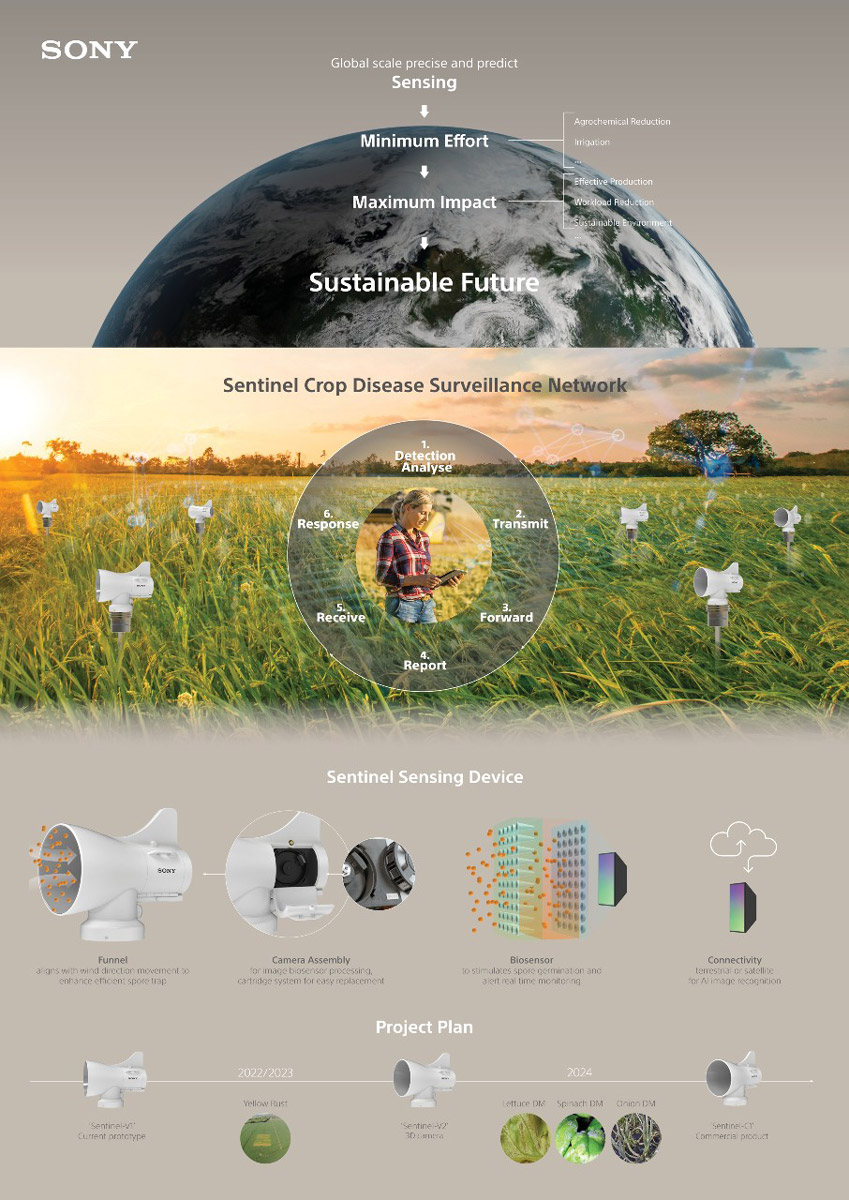
Sentinel Downy Mildew Sensors
Sentinel aims to create a solution to checking for disease using several, identical sensing devices located in the crop field.
The data from each sensor provides an early warning of the presence of a pathogen which is turned into a recommended management plan for the grower. Each device comprises a biosensor that stimulates the targeted pathogen spore to germinate, a smart camera to detect that growth, a set of environmental sensors and a wireless communication module all housed in a weatherproof, robust housing.
Expected Outcomes
The project aims to target three different pathogens – yellow rust, brown rust and downy mildew both in the UK and abroad.
Sony is building on its expertise in low-cost electronics and imaging to develop innovative tools for the agritech sector. Detailed global market study for Sentinel has been completed to explore the industry landscape and field trials of the product started in 2023.
Partners
Sony, NIAB, One Nine Design Ltd, Rothamsted Research, University of Manchester, G’s Fresh Ltd, Omya Ltd
Duration
2022-2025
Controlled Environment Lighting at Second Willow
The challenge for salad producers is producing vegetable transplants using reduced energy inputs and having increased quality and resilience to abiotic stress during the post transplanting stage of establishment.
This project will study plant growth and RSA development in the greenhouse in response to LED light treatments (spectrum, irradiance, timing and duration) and subsequent plant performance in the field.
Expected Outcomes
We will quantify expression of key rooting genes linked to light-responsive rooting traits under key lighting treatments to better understand the molecular basis of the trait in these crops.
The project will utilise germplasm from three partner breeders to:
a) Optimise genotype x lighting responses, and
b) Identify breeding material for future development towards optimised propagation of novel varieties.
Duration
2023-2025

AKT Knowledge Transfer Partnership with Essex University
Non-Invasive Technological Approaches to Crop Health Detection
Innovate UK’s Accelerated Knowledge Transfer (AKT) scheme has been designed to create short-term collaborations between businesses and knowledge bases, such as universities.
We are aiming to improve crop health by learning more about plants and the nutrients required at each stage of their growth.
The project will partner with Essex University academics in the School of Life Sciences, to find a non-destructive, remote-sensing based detection system.
Expected Outcomes
The project will help speed up the analysis process, allowing growers to respond quicker to different types of crop stress, something made increasingly prevalent by climate change, regulations around pesticides and financial pressures caused by rising fertilizer prices.
The information identified in this project will encompass detection methods at different stages ranging between laboratory testing to commercial. This exploratory analysis will pave the way for further development or adoption of these technologies at G’s Growers.
Duration
2024